- Making It
- Posts
- A movie for tomorrow’s hangover
A movie for tomorrow’s hangover
Plus next year’s goals and why Mary Neely won 2025

GG Hawkins
December 31, 2025

Mary Neely in Or Something
Happy almost new year! I watched Marty Supreme at the AMC Bay Street in Emeryville, my old movie/mall haunt from middle school where I used to spray A&F Fierce on my purse before movie hopping or hiding in the shelves of Barnes and Nobles.
My husband and I loved Marty Supreme. My dad and step mom hated it and went home to watch Elf — which, for the record, is a also great.
My 2026 goals are to turn my short story Think of Me Like A Mother into a feature script, get strong, and make another movie. For the latter, maybe it will be In Bed With Me, which was at the Gotham Project Market this year, and I’ve attached two producers and am taking it out in the new year. Maybe another microbudget with some of my favorite people. Maybe both.

Think of Me Like a Mother
But before midnight hits, I want to talk about someone who, in my opinion, won microbudget filmmaking this year: Mary Neely. Grit, grind and DMs led to a prolific 2025: She starred in, co-created, and co-wrote Stars Diner, which premiered at SXSW, while also shepherding the feature Or Something from a deeply personal idea to actual audiences, in actual theaters, and now onto MUBI. That arc alone is impressive. The way she did it — with specificity, taste, stamina, and zero reliance on the “approved” paths — is what makes it worth paying attention to.
Because here’s the part people don’t glamorize enough: getting a movie out into the world is exhausting. In some ways, more exhausting than making it. You can hear that burnout in my own voice on a recent No Film School episode, where I talk about the strange emotional crash that comes after release — when the movie exists, but you’re still fighting for people to actually see it.
Or Something found its audience slowly and honestly. It had a theatrical run at the Quad in Manhattan that kept extending. It played Brain Dead in LA. TIFF Lightbox in Toronto. It lives on planes, on VOD, and now — this week — it lands on MUBI. That didn’t happen because the industry anointed it. It happened because Mary and her collaborators, namely Kareem Rahma of Subway Takes but also a perfect distributor working our of his Brooklyn apartment for the love of movies, understood what kind of film they made, who it was for, and how to protect it long enough for the audience to catch up.
Which is why this felt like the perfect film — and the perfect filmmaker — to sit with in this in-between moment. A movie for tomorrow’s hangover. And maybe, if you’re paying attention, a quiet roadmap for next year.
Below is our latest Work in Progress conversation — a deep dive into how Or Something came to be, how it found distribution without chasing mythical “top-tier” validation, and what it actually looks like to keep going when the map no longer matches the terrain. We should all take notes.
House Keeping
I’m teaching Microbudget Mindset in February with Indie Empire (use code GG25 to get 25% off).
I’m co-hosting a dinner at Sundance with Stewart Cory for women in the business of film. It takes place on opening night at High West. We’re looking for a few more sponsors—let me know if you’re interested in joining us.
Tomorrow, I’m dropping an NFS pod episode that’s a little different: a conversation between me and my film’s composer, Hollie Buhagiar. We do a step-by-step breakdown of our scoring process, walking through two cues at various stages of creation—how we gave notes, how the cues evolved, and where we misunderstood each other. We’ve been sitting on this episode for over a year, waiting for the soundtrack to drop, and I think it’s pretty unique—unlike anything I’ve seen or heard in this space, and hopefully genuinely helpful for filmmakers.
(I also open the episode with a conversation with Pete Ohs, who edited Or Something about his attempt to make distribution fun. Small world.) Here’s a sneak peak: https://www.podtrac.com/pts/redirect.mp3/pdst.fm/e/traffic.megaphone.fm/NFS5402421134.mp3
WORK IN PROGRESS feat. Or Something’s Mary Neely
Work in Progress deep dives into microbudget films—and the filmmakers behind them—as they navigate the process of making their movie. |
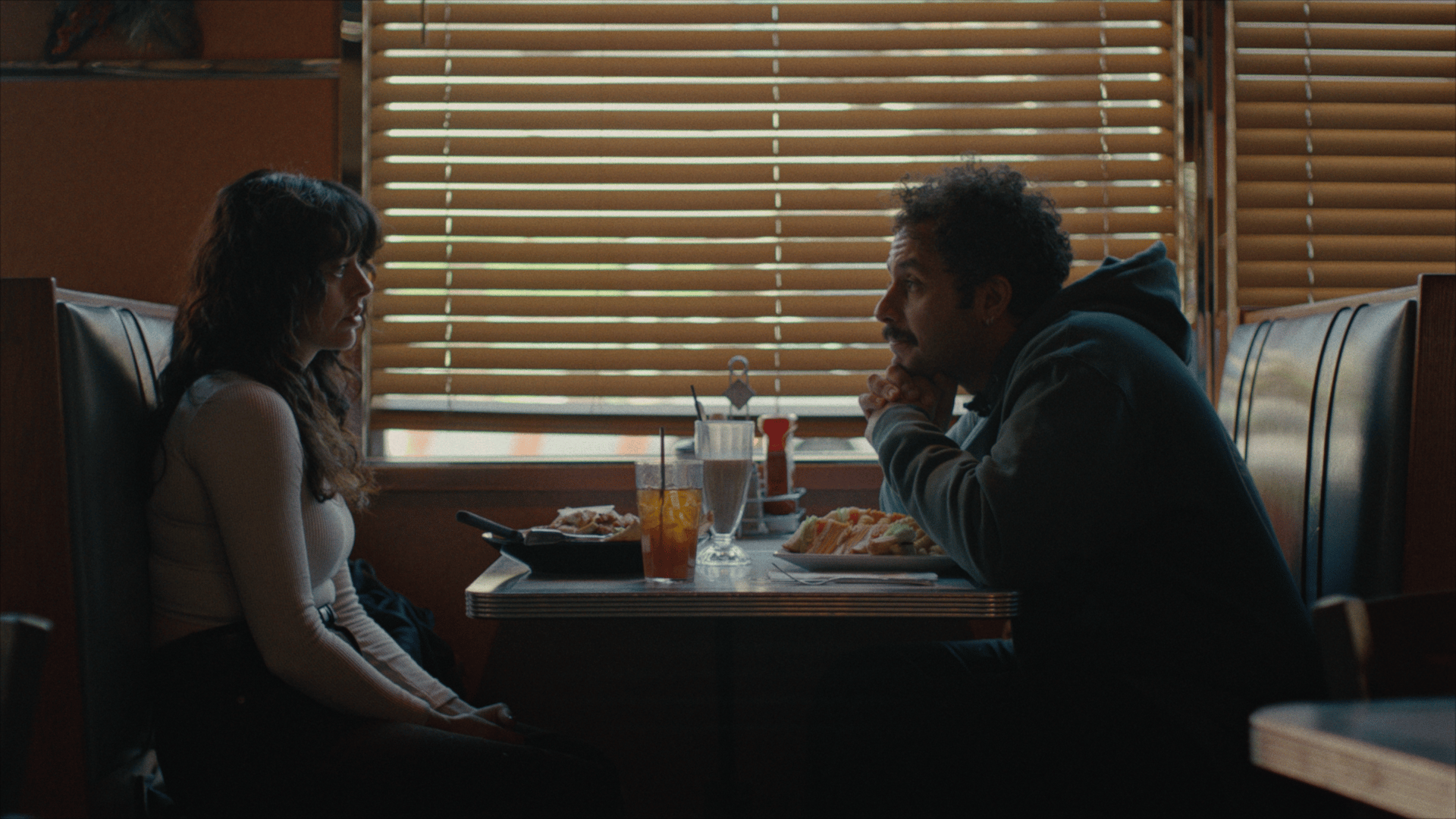
What was that moment like when you realized audiences were responding so strongly to the film?
I was at a premiere for a $20M feature film made by some heavy hitters, and at the after-party, a woman stopped me to say she had not only seen "Or Something" during our run at the Quad but that it was "much better" than the movie we had just watched. While everything is incredibly subjective, I can't pretend that it didn't feel like a turning point.
You've spoken about how "Or Something" didn't play at any top-tier festivals — i hate the idea of top-tier. It’s giving me Greek life flashbacks… Yet it still secured theatrical distribution with Factory25 and is now premiering on MUBI. Given the changing landscape for independent films, what advice would you give to filmmakers who don't get into one of those fests?
Taking things into your own hands, being realistic about the types of spaces your film fits into, and what kind of life it will have. That doesn't mean being pessimistic; it means doing your research. When Kareem and I set out to make the film, we were inspired by Mumblecore filmmakers of the early 2000s (low-budget execution, character/dialogue-driven stories). Yet the business models have obviously changed significantly. In 2008, a filmmaker like Joe Swanberg could make a movie like "Nights and Weekends" for $15K, premiere it at South by Southwest, sell it to IFC for $15K, and then use that money to make "Alexander the Last." Repeat, repeat, etc. During our festival run, I was having a tough time wrapping my head around who the IFC of today is, since IFC has become much more commercial in recent years.
When we were showing the film in London with Deeper Into Movies, I asked Steven Hanley, who runs Deeper, which distribution company actually acquires microbudget films. He immediately said fellow analog film lover Matt Grady, who runs Factory25 out of his brownstone apartment in Brooklyn. This was also when "Subway Takes" was just starting to gain a bit of an audience, so I told Kareem to send the email to Matt. We didn't pitch the film to any other distributors because I think taking that pointed, specific approach is really effective.
Your first impression was that Kareem had his "shirt unbuttoned way, way too much." When did you realize this person you were roasting dating app profiles with during "the audit" sessions would become your creative partner on a feature film?
We kept having these long New York nights where we would go dancing or to parties, and we were always making silly videos and ending up in long conversations, debates. We were both in phases of our lives where we wanted to push beyond previous versions of ourselves, even though that looked very different for each of us. So when he posted an Instagram story with a screenshot of Mathieu Kassovitz's 1996 classic "La Haine" with the caption, "I'm quitting comedy until someone casts me in a dramatic roleI wanna be in a movie like this one, please" it just felt like a natural progression of our relationship for me to answer, "Ya I'll cast you."

Kareem’s post threatening to quit comedy.
You and Kareem would meet up once a month and essentially have arguments, then transcribe those conversations into the script. That's such an unusual writing process, but something we also did with I Really Love My Husband, and it yielded results that I love. When did you know you had something that could become a full film rather than just interesting conversations?
Before we started having those conversations (and arguments), we mapped out a structure to justify sustaining that much dialogue. It became about choosing free or cheap locations, emotional stakes, tension, and then deciding what kinds of conversations fit within that framework. Since it's a film about two people spending the day together, we aimed to be very intentional about the blossoming of vulnerability between two strangers as they get to know each other. We wanted the plot, regardless of the dialogue, to stand on its own.
The film was shot in six days for "significantly under" half a million dollars. Can you walk me through what that budget constraint meant for the production? What's an example of a scene or moment in the film that wouldn't have existed if you'd had a bigger budget?
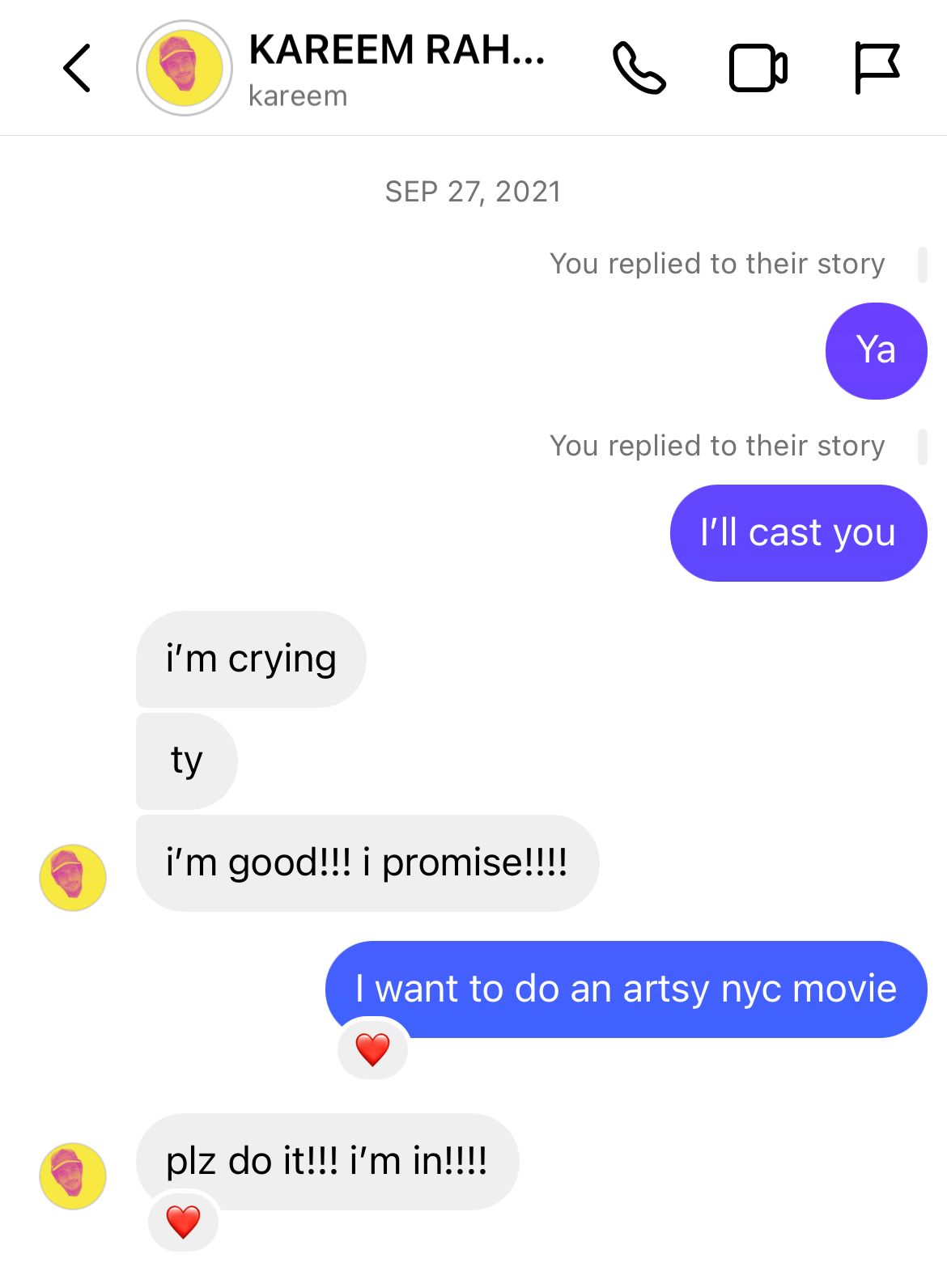
Mary casting Kareem in a movie via DM
It would not have been shot primarily outdoors at the end of December. Thank you once again to our crew and to the inventor of Hothands.
You've said you wanted to go to some darker places and give yourselves roles you wouldn't normally be thought of for. What was scary about writing those vulnerable moments, and how did you let yourself go there?
There's an inherent barrier just by the nature of this being a fictional piece. That buffer is significant, since we live in an era rife with scrutiny. It was relatively easy in the scriptwriting process to be vulnerable and honest. I had more internal mayhem when audiences were first seeing the film because my opinions had changed since we wrote the script. It was like I had forgotten about the natural fictional barrier and felt like someone was going to "catch" me. It was interesting to gain awareness of how fixed our culture feels and how I've played into that myself—an uncomfortable lesson in flexibility.
Your viral Broadway videos during COVID led directly to this film through Wil Shipley's DM offering to fund you. You thought he was lying and ignored him for a year. What finally convinced you it was real, and how did that shape your approach to the project?
His earnest persistence felt different from others who had promised similar patronage in the past. When I finally accepted his offer, I took it very seriously and wanted to see how far I could push myself so as to get the most out of such a novel opportunity.
The film is now available on VOD platforms and as in-flight entertainment on United and Emirates, and it's about to premiere on MUBI. What does this extended life of the film mean to you after such a scrappy beginning?
Like Alan Ball once wrote, "It's hard to stay mad when there’s so much beauty in the world. Sometimes I feel like I’m seeing it all at once, and it’s too much; my heart fills up like a balloon that’s about to burst. And then I remember to relax, and stop trying to hold onto it. And then it flows through me like rain, and I can’t feel anything but gratitude—for every single moment of my stupid, little life." That's how I feel every time someone sends me a photo of our movie on a plastic plane tv.
Would you make another microbudget?
Yes, I'm gearing up to make another right now. It's like childbirth, I'm so far away from the pain that it feels totally fine and exciting to have a second, especially since I learned so much from having the first.